Supersession Audit
Per-sheet walkthrough — L1 Reconciliation Dashboard.
What the sheet shows
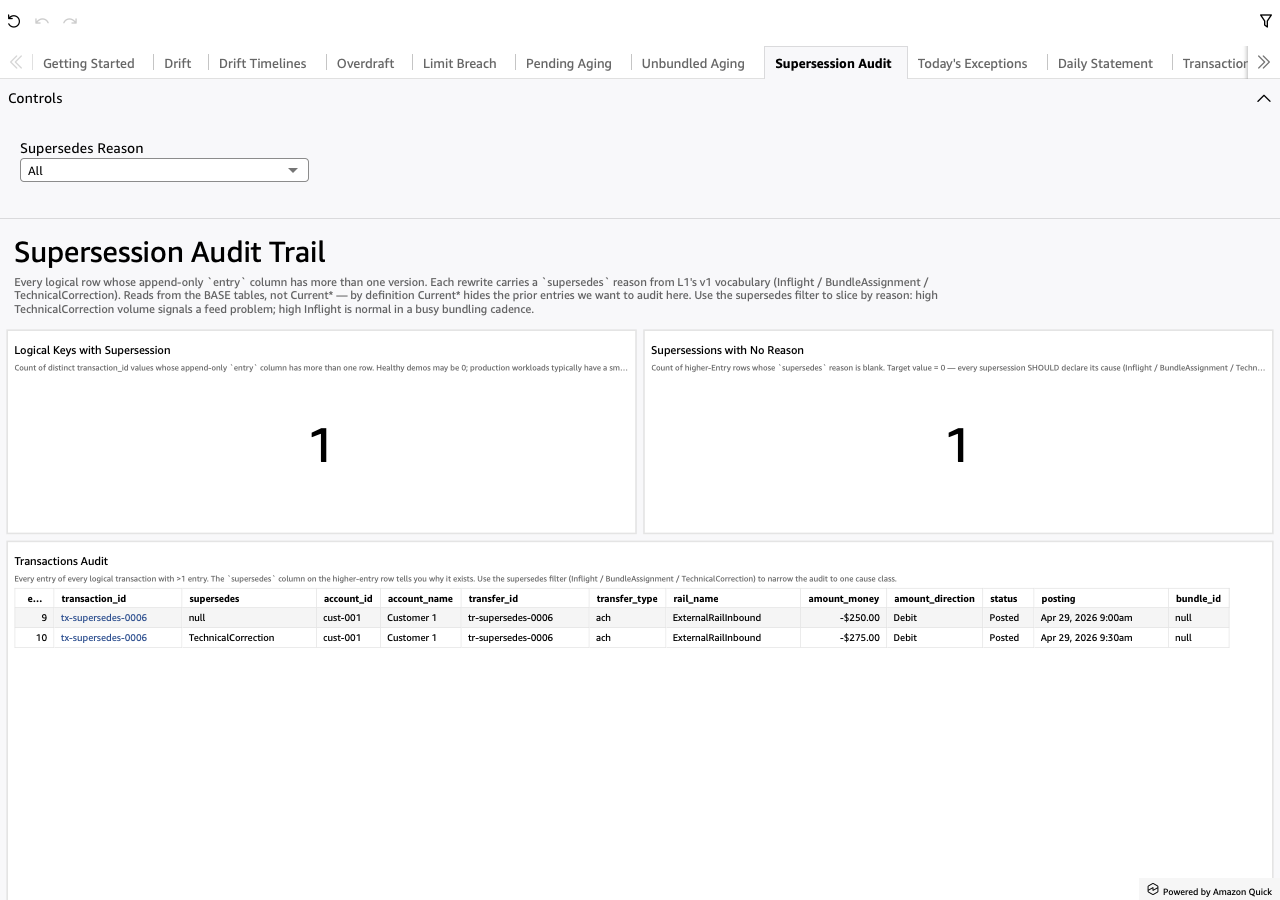
Every logical row whose append-only entry column carries more than one
version. Each rewrite stamps a supersedes reason from L1's v1
vocabulary:
- Inflight — rewritten while still in flight (typical: status flip or late metadata enrichment).
- BundleAssignment — rewritten when an AggregatingRail picked the row
up and assigned a
bundle_id. - TechnicalCorrection — rewritten because the original posting was wrong (amount fix, account swap, etc).
Reads from the BASE tables (spec_example_transactions,
spec_example_daily_balances), NOT the Current matviews — by
definition Current hides the prior entries we want to audit here.
Screenshot
When to use it
Diagnostic deep-dive. High TechnicalCorrection volume signals a feed
problem upstream; high Inflight is normal in a busy bundling cadence.
Also useful for cross-system reconciliation — does our rewrite count
match the producer system's known correction count?
Visuals
Three KPIs across the top, then two audit tables.
- Logical Keys (Transactions) with Supersession (KPI) — count of
distinct
transaction_idvalues whose append-onlyentrycolumn has more than one row. Unit is distinct KEYS. - Supersession $ Exposure (KPI) — sum of
|amount_money|across superseded transaction entries. The dollar magnitude of the audit surface; counts alone leave "how much money do these revisions move?" open. - Supersession Rows with No Reason (KPI) — count of higher-
entryrows whosesupersedesreason is blank. Unit is ROWS not keys (one key may hold several no-reason rows). Target is 0 — every supersession SHOULD declare its cause per the L1 SPEC. - Transactions Audit (Table) — every entry of every superseded
logical transaction, ordered by
(transaction_id, entry)so the audit trail reads top-down per logical row. Thesupersedescolumn on the higher-entry row tells you why it exists. - Daily Balances Audit (Table) — same shape on the
(account_id, business_day_start)composite key. Themoneycolumn changing across entries is the trail for an end-of-day re-statement.
Drills
Three outbound, all on the table cells:
- Transactions Audit, transaction_id (left-click) — same-sheet self-filter: focus the audit on that one transaction's full entry trail. It's a control-write, not a URL nav, so it dodges the QS URL-param-no-control-sync quirk. Clear it via the Transaction ID dropdown to return to all.
- Transactions Audit, transfer_id (right-click) — cross-sheet to the
Transactions sheet's legs-of-this-transfer view. The Current* sheet is
max-entry-only, so a
transaction_idlands on a single useless row there — hencetransfer_idfor that hop. - Daily Balances Audit, account_id (right-click) — cross-sheet to the Daily Statement for that account-day.
Filters
- Supersedes Reason — narrow the transactions table to one cause class (Inflight / BundleAssignment / TechnicalCorrection).
- Reason Provided — isolate the policy-violation rows (a higher-entry supersession lacking a reason) from rows that carry one. A distinct axis from Supersedes Reason: this narrows by PRESENCE, not by cause class.
- Transaction ID — pick one superseded transaction to focus its
trail. Shares the param the
transaction_idcell drill writes — the drill focuses, this dropdown is the discoverable picker plus the clear affordance.
The daily-balances table gets NO paired filter — supersession on daily_balances is rare enough that a second control would be noise.
No date filter — audits want the full historical horizon.